
Website | Compiled by SedNet Secretariat | Subscription Service: SedNet Secretariat | Previous Issues
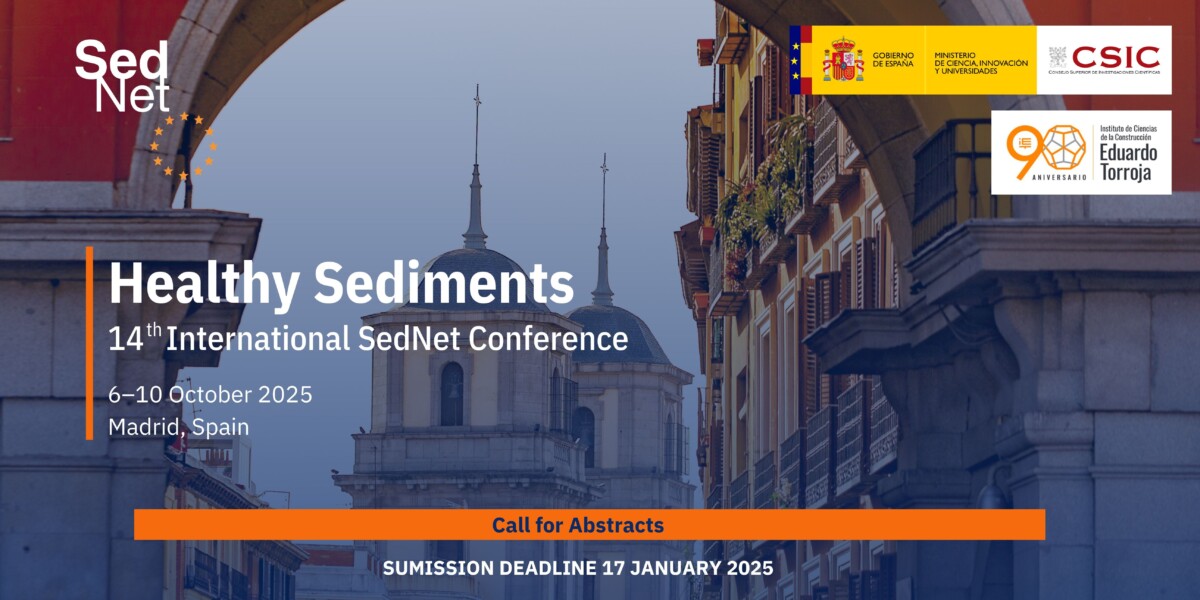
From the 6th until the 10th of October 2025 the SedNet conference will take place in Madrid, Spain. At the conference, we invite abstracts for a series of sessions aiming to explore
different challenges and proposed solutions related to the theme “Healthy Sediments”.
Sediments fulfil fundamental functions as riverbeds, aquatic habitats, and play an integral role in the biogeochemical cycles of aquatic systems. Due to their quality and quantity, sediments have key functions for indispensable ecosystem services, including important human uses of water bodies.
In line with the objectives of the European Water Framework Directive (WFD), Marine Strategy Framework Directive (MSFD), Mission Starfish 2030 (aiming to restore our oceans and waters), and the Green Deal (aiming for zero pollution), sediments must be healthy to help regenerate biodiversity, create good conditions for the provision of habitats and ecosystem services, and contribute to the good chemical and ecological status of water bodies. Water pollution causes sediments to function both as sinks and sources of pollutants. The remobilisation and transport of these polluted sediments can potentially negatively impact water quality and, consequently, the health of aquatic organisms. Additionally, activities such as mining and river regulation disrupt the natural sediment flow. To meet the objectives of European environmental policies, it is essential to achieve healthy sediments. We therefore need to define what constitutes healthy sediments and, thereafter, protect and, where needed, restore their health and balance. A strategy is needed to ensure the sustainable management and use of sediments.
In summary, healthy sediments are key to supporting life, maintaining biodiversity, enriching soil, and sustaining ecosystems. But how can the health of sediments be defined? What indicators can be used for assessment? We are inviting abstracts for a series of sessions addressing various challenges and proposed solutions to the overall 2025 SedNet conference theme: “Healthy Sediments”.
We tentatively propose six thematic sessions for the conference:
1. Zero Pollution
2. Sediment Flows
3. Nature Based Solutions
4. Sediment Literacy & Citizen Science
5. Data Collecting, Sharing and AI
6. Sediment Management Concepts and Policy
Abstracts must be sent to the SedNet Secretariat. For questions, please also contact the SedNet Secretariat.
The submission deadline for abstracts has been extended to Friday, 17th of January 2025.
Stay tuned for more details about the conference and registrations!
The Table of Contents for Journal of Soils and Sediments, Volume 24, Issue 12, is now available online. This special issue showcases contributions from the SedNet 2023 Conference.
Click the button below to explore the latest JSS issue and discover these insightful articles.
The Journal of Frontiers in Marine Science accepted a paper on the Beneficial Use (BU) of sediments. This study explores the impact of initial conditions on the consolidation of dredged sediment.
The sediment, sourced from Lake Markermeer in the Netherlands, was analyzed within the context of the Marker Wadden Building with Nature project. Material parameters were determined using two distinct experimental methods. Differences observed between the two sets of material parameters suggest that stress history and plastic deformation during mixing may influence the results. These effects were further examined using a one-dimensional vertical (1DV) consolidation model, with the computed density profiles compared against measurements obtained using an Ultrasonic High Concentration Meter. The findings contribute to the BU of sediments by providing new insights into methods for determining and estimating the material parameters of dredged sediment, its mechanical behavior, and its evolution over time.
Click the button below to read the full paper.
A research group at Chalmers University of Technology is conducting a study on current sediment management practices to explore both present and future options, along with their respective advantages and disadvantages. The study also aims to identify barriers and opportunities in sediment management.
To support this research, the group kindly invites the SedNet network to complete a short questionnaire, which will take approximately 10 minutes to complete. The deadline for submission is March 31, 2025.
Please click the button below to access the questionnaire.
The EGU General Assembly 2025 (EGU25) will take place in Vienna and online in a hybrid format from 27 April to 2 May 2025.
Participants are encouraged to contribute to this event by submitting their abstracts before the deadline: Wednesday, 15 January 2025, at 13:00 CET.
Two dynamic sessions will focus on hydro-morphological processes in open water environments, showcasing both numerical modeling and advanced measurement and monitoring techniques. These sessions will include oral and poster presentations, held at the Vienna conference venue.
Session Details:
HS9.2 Hydro-morphological processes in open water environments – numerical modelling
Convener: Gábor Fleit | Co-conveners: Ronja Ehlers, Stefan Achleitner, Nils Rüther
HS9.3 Hydro-morphological processes in open water environments – measurement and monitoring techniques
Convener: Yannic Fuchs | Co-conveners: Kordula Schwarzwälder, Slaven Conevski, Rui Aleixo
The organizers look forward to welcoming participants and greatly value the insights and contributions that will help advance knowledge and discussions
in morphodynamics.

Copyright © 2026 SedNet, All rights reserved.
Our mailing address is:
SedNet Secretariat
Vasteland 78
3011 BN Rotterdam
The Netherlands