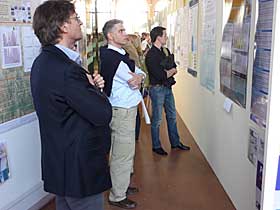
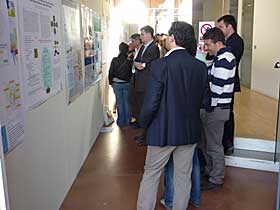
Poster Award
The best poster was awarded with a prize sponsored by the Journal of Soils and Sediments.
The winning poster was “River Sediment Sampling and Sediment Environmental Quality Standards” presented by Ngozi Mokwe-Ozonzeadi of the University of Westminister / Natural History Museum, UK.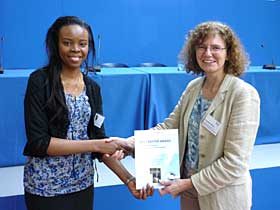 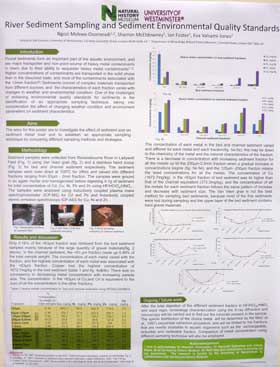 |
| 1. Biodiversity / Risk Assessment |
| • | Impacts of drought and flooding on the biological activities in sediments
Simonetta Rubol et al, Università Degli Studi di Trento. Italy |
| • | Use of sand in environmental requalification in Venice lagoon
Giovanni Cecconi, Consorzio Venezia Nuova, c/o Thetis SPA, Italy |
| • | First insights into the bacterial communities in contaminated sediments of the Deûle River (Northern France)
Stéphanie Roosa, University of Mons, Belgium |
| • | The activity of sediment bacteria in a temporary river in relation to the hydrological status and to the persistence of organic pollutants
Alberto Puddu, IRSA-CNR, Italy |
| • | Different approaches for evaluating benthos quality in Lake Maggiore
Elisa Bizzotto, ENVIRON, Italy |
| • | Spatiotemporal variability of microphytobenthos in the coastal lagoon of Cabras (Sardinia, Italy)
Francesca Di Pippo, University of Rome “Tor Vergata”, Italy |
| • | Differences in resilience of benthic habitats to dredge disposal
Gert van Hoey, Institute for Agricultural and Fisheries Research, Belgium |
| • | Translocation and re-use of dredged sediment: bioavailability and toxicity evaluation using the brittlestar Amphipholis squamata
Elisa Volpato, Thetis SPA, Italy |
| • | A multiple biomarker approach to assess the toxicity of re-suspended sediments during simulated flood events – a feasibility study
S. Hudjetz, Institute for Environmental Research, Germany |
| • | Risk Assessment Using Sediment Suspensions With Aquatic Toxicity Test
Hülya Böke Özkoç, University of Ondokuz Mayıs, Turkey |
| • | Sensitivity comparison of different sediment bioassays – Case study Antwerp harbor, Belgium
Ivana Planojevic, University of Antwerp, Belgium |
| • | Development of a ‘weight-of-evidence’ model for assessing sediment quality and associated hazards
Francesco Regoli, Università Politecnica delle Marche, Italy |
| • | Sustainable Management of Contaminated Sediments, SMOCS
Göran Holm, Swedish Geotechnical Institute, Sweden |
| • | Trace element regressions in coastal sediments from the Tuscany Region (Italy)
Nicola Bigongiari, Centro Interuniversitario di Biologia marina ed Ecologia Applicata, Italy |
| • | Sediment Toxicity Tests on Aquatic Biota
Hülya Böke Özkoç, University of Ondokuz Mayıs, Turkey |
| • | Integrated approach for chemical and ecotoxicological evaluation of environmental quality in sediments from the Mar Piccolo of Taranto
Santina Giandomenico, Institute for coastal marine environment, Italy |
| 2. Policy and Management (incl. RBM and coastal zone management) |
| • | Waste, Resource or Liability? Alternative Decision Criteria to Support More Sustainable Sediment Management
Sabine E. Aptitz, SEA Environmental Decisions, UK |
| • | AMORAS – Antwerp mechanical dewatering, recycling and application of sediments
Joris Dockx, Flemish Government, Department Mobility and Public Works, Maritime Access, Belgium |
| • | Sediment Management Plan in Port of Taranto
Francesca Giaime, ISPRA, Italy |
| • | Binder Stabilization of Sediments for Reclamation of a Surface Impoundment
Vito Schifano, ARCADIS US Inc, USA |
| • | Quantification and Monitoring of Water and Contaminant Migration to Sediment via Groundwater-Surface Water Interaction
Bart Chadwick, Coastal Monitoring Associates, USA |
| • | Use of carbon-amended composite particles to accomplish in-situ treatment of contaminated sediments
Joseph Jersak, Biologge AS, Norway |
| • | A regional approach: The Slufter and the river Rhine Basin
Arie Noordwijk, Port of Rotterdam Authority, The Netherlands |
| • | The dredging of the Oil Port of Genoa Multedo (Italy): the on-site monitoring solutions
Marco Capello, University of Genoa, Italy |
| • | Treatment of contaminated dredged sediment by using a membrane bioreactor
Jan Svojitka, School of Life Sciences, Institute for Ecopreneurship, University of Applied Sciences Northwestern Switzerland, Switzerland |
| • | The sediments management guidelines for the lagoon of Venice: a “stakeholder” point of view on 17 years of discussions
Laura Montobbio, Consorzio Venezia Nuova, Italy |
| • | The TIDE-Project –Sustainable Tidal River Development in North Sea Region Estuaries
Kay Hamer, Department of Geosciences-University of Bremen, Germany |
| • | Metallic and organic pollutant (lead and PCB) historical trends as recorded by Rhone river sediments
Gwennaelle Roux, Laboratoire des Sciences de l’Environnement – Ecole Nationale des Travaux Publics de l’Etat, France |
| • | River Sediment Sampling and Analysis for Selected Heavy Metals; establishing a practical protocol
Ngozi Mokwe-Ozonzeadi, University of Westminster, UK |
| • | Sustainable Approaches to the Assessment, Risk and Remediation of Urban Watershed Waterways Utilizing SSWiM Strategies
Eric A. Stern, Environmental Resource Management (ERM), USA |
| 3. Monitoring / Modelling |
| • | As-related bacterial activities in marine sediments
Fabienne Battaglia-Brunet, BRGM, France |
| • | Historical accumulation of mercury from mining and industrial activities (Marano & Grado Lagoon, northern Adriatic sea)
Stefano Covelli, Department of Geosciences, University of Trieste, Italy |
| • | Methyl mercury in sediments and its cycling in the Lagoon of Venice: a synthesis of multi-compartment study
Stéphane Guédron, University of Geneva, Switzerland |
| • | Total and Methyl mercury bioavailability in the lagoon of Venice: accumulation kinetics in Chironomus salinarius
Frédéric Gimbert, Université de Franche-Comté, France |
| • | Heavy metals accumulation areas in the Venice Lagoon sediments
Margherita Botter, Institute of Marine Sciences, Italy |
| • | PCB fluxes from the sediment to the water column following resuspension – A column experiment
Philippe Bataillard, BRGM, France |
| • | Monitoring the downstream effects of dredging in a small lowland river polluted with heavy metals
Dieter Meire, Ghent University, Belgium |
| • | Water-soluble ionic species in river-bottom sediments of the Pangani Basin, Tanzania
Harieth Hellar-Kihampa, University of Antwerp, Belgium |
| • | Ecotoxicity evaluation of dredged sediments application on agricultural and with contact soil bioassays
Jana Vašíková, Masaryk University, Czech Republic |
| • | Inhibitory effect of sediment pollution on Baltic amphipod Monoporeia affinis
Evita Strode, University of Latvia, Latvia |
| • | Sulfonamide residues in coastal marine sediments
Grzegorz Siedlewicz, Institute of Oceanology, Poland |
| • | Anionic surfactant linear alkylbenzene sulphonates (LAS) in sediments from the southern Baltic Sea and its environmental implications
Ksenia Pazdro, Institute of Oceanology, Poland |
| • | Ecotoxicological evaluation of sediments: establishment of recommendations in Switzerland
Rebecca Fluck, Swiss Centre for applied ecotoxicology Eawag/EPFL, Switzerland |
| • | Investigations on the gas permeability of geo synthetics
Dirk Lesemann, Knabe Enders Dührkop Ingenieure GmbH, Germany |
| • | Trace elements in sediments and floodplain soils of the Wieprz river, Poland
Izabela Bojakowska, Polish Geological Institute – National Research Institute, Poland |
| • | Long-term migration of heavy metals in the small catchment affected by historical lead and zinc mining
Dariusz Ciszewski, AGH University of Science and Technology, Poland |
| • | A model for calculation of sediment capping of polluted sediments
Henrik Rye, SINTEF, Marine Environmental Technology, Norway |
| • | ADCP and CTD evaluations of the nepheloid-layer pathway for a mathematical dredging of relict sand for beach nourishment (Tuscany, Italy)
Marco Capello, CONISMA, Italy |
| • | Deposition and erosion properties of fine sediments from an area of saltpans in the Ria de Aveiro lagoon
Luis Portela, National Laboratory of Civil Engineering, Portugal |
| • | Pharmaceuticals in the Ebor river basin: Occurrence and distribution between aqueous and solid phase
Barcelo Damia, Department of Environmental Chemistry, IDAEA-CSIC, Spain |
| • | Sediment monitoring of PAHs for the European Water Framework Directive: the case of the Marano and Grado Lagoon (Italy)
Alessandro Acquavita, ARPA-FVG, Osservatorio Alto Adriatico, Italy |
| • | Efflux of Metals from Contaminated Marine Sediments due to Bacterial Remineralisation of Phytodetritus
David Gillan, Mons University (UMons), Belgium |
| • | Distribution and Accumulation of Heavy Metals in Sediments from the mid-Black Sea coast of Turkey
Sema Ariman, Samsun Province Private Administration, Turkey |
| • | Trace elements and application of the environmental quality standards (WFD) in the Marano-Grado Lagoon (North Adriatic Sea, Italy)
Alessandro Acquavita, ARPA-FVG, Osservatorio Alto Adriatico, Italy |
| • | Chemical quality of river sediments in France – summary of available databases
Pierre Hennebert, INERIS – Institut National de l’Environnement Industriel et des Risques, France |
| • | MACISTE-PS: an information system to manage environmental data from the dredging of the Port of Genoa (Italy)
Francesco Massa, University of Genoa, Italy |
| • | Geochronological Dating of Sediments from Pallanza Bay
Karen Merritt, ENVIRON U.S., Maine, USA |
| • | Pathogenic Vibrio spp. in coastal sediments
Nicole Brennholt, Federal Institute of Hydrology, Germany |
| • | Screening of metal content in Begej (Serbia) river basin
Dejan Krcmar, University of Novi Sad Faculty of Sciences, Serbia |
| • | The GeDSeT Project: How to assess the impact of a dredging operation?
Claire Alary, EMDouai, Lille, France |
| • | Characterizing Hydrodynamics and Sediment Transport in a Port Facility
Craig Jones, Sea Engineering, Santa Cruz, USA |